Posts

Showing posts with the label Poetry in the EFL classroom

Shakespeare in Love: a Teaching Scenario about Shakespeare

Image
Talking about Shakespeare and using his works in the EFL classroom can always be risky as we all know how difficult they are to understand without adequate guidance not to mention that the original works feel overwhelming for anyone who is less than a literature student. However there is no reason why we should deprive our students of the pleasure to experience some of Shakespeare's magic that has stood the test of time and is still meaningful today. Romeo and Juliet, Frank Bernard Dicksee (1853–1928), Southampton City Art Gallery The following learning scenario was designed entirely for the e-class (a digital learning platform for the Greek schools) during the quarantine but it can be used in the classroom provided that there is a computer lab available or a classroom with a wireless connection and enough laptops and tablets for the students to work on.  Students are going to learn about William Shakespeare, the greatest English playwright, and why he is so significant. They are ...

Fun Ways to Celebrate 'World Poetry Day'

Image
21st March is World Poetry Day . It is a celebration of poetry for everyone, everywhere. It's a day to promote the reading, writing and teaching of poetry and to connect it with the other arts such as theatre, dance, music and painting. It is a chance to use poetry to say things that can’t be said in prose. Photo by congerdesign How can we use poetry in the EFL classroom and have fun with our students on this day? Here are some ideas: An easy way to start is by reading and writing haikus.  They are short, easy to write and memorise and can be used with students of any age and level. They are made of three lines with five, seven, five syllables respectively and their themes are usually inspired by nature. For ideas on how to write haikus on paper or online you can visit an older post here. I am poems : students can talk about themselves and  express the way they feel, what they hope, think, dream, enjoy and so on.  The lines in each poem begin the same way: I a...

"Zebra Question" by Shel Silverstein

Image
It seems that I have a soft spot for Shel Silverstein's writings.  They are simple yet so rich in meanings and they are always accompanied with straightforward illustrations that make them ideal for children and adults alike. Three years ago I created a short lesson on  The Missing Piece Meets the Big O . This year I made a short video for one of Silverstein's short poems, the  "Zebra Question".  photo by  VIKTOR HANACEK Zebra Question is a poem from the book  A Light in the Attic , published in 1981. It is about a boy who asks a zebra whether it is black with white stripes or white with black stripes. The zebra replies somewhat sassily with an exhaustive list of questions: "Are you good with bad habits? Or are you bad with good habits? Are you noisy with quiet times? Or quiet with noisy times? and on and on and on in a repetitive way. The poem reminds us to look at situations but also at ourselves from different perspectives. Not...

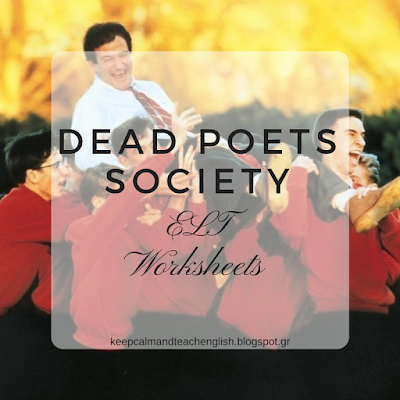
Dead Poets Society Worksheets

Image
The 21st March is  World Poetry Day  and it is an excellent opportunity to show students a film I am particularly fond of (in fact most teachers are): Dead Poets Society. Dead Poets Society   is a 1989 American drama film directed by Peter Weir, written by Tom Schulman, and starring Robin Williams. Set in 1959 at the fictional elite conservative boarding school Welton Academy, it tells the story of an English teacher who inspires his students through his teaching of poetry. There are tons of worksheets out there for both native and EFL students focusing on different aspects of the film. The film itself is very rich in  literature material and can provoke discussions on many issues like poetry, conformity, education, the list goes on.  The following worksheets are inspired by the ones found on the internet so in this sense they are not original. However they are written with my students in mind (ideally 15-18 year olds at B1+ level) and ...

"Life Doesn’t Frighten Me" by Maya Angelou

Image
This poem, written in a voice of a girl, addresses the fears children face in their everyday life. The narrator presents a fearless attitude when she speaks of common childhood fears - undefined noises and sounds, ghosts, strangers - but this bravado is only a mask she uses to try and hide her true fears. Step 1: Before reading / listening to the poem, students can list some of their own fears and compare them with their partners.  Step 2: After reading the poem students can be asked to identify and discuss phrases or words that were important or meaningful to them, or ones that moved them in particular. A challenging approach you could follow for this step is the one described in Chrysa Papalazarou's blog  for capturing the essence of a text. Step 3: As a follow up activity they can write their own poems using their own fears (from step 1) and following the format of the poem. You can also hand them out blank papers and let them use their imag...

Writing a Haiku

Image
Writing haikus is a popular activity in education as they are simple to write, read and memorise. Their short, fixed form make them easily accessible to students of any age and level. Below is a simple lesson idea where students analyse the form of haikus and later are invited to write their own. If computers are available, students can use the Haiku Poem Interactive  found in  readwritethink.org/ .

Concrete or Visual Poetry

Image
A fun way to introduce or re-introduce Poetry in the EFL classroom is through concrete or visual poetry where the poem is arranged in a way that illustrates its theme. Concrete poetry can be playful and creative enough without having to be complicated or comforming to rules.

Little Red Riding Hood and the Wolf... with a Twist

Image
Roald Dahl's Revolting Rhymes is a collection of poems published in 1982. They are a parody of traditional folk tales in verse. Dahl gives a re-interpretation of six well-known fairy tales, featuring surprise endings in place of the traditional happily-ever-after. They are known for their unsentimental, often very dark humour. photo by  Kai_Vogel Little Red Riding Hood and the Wolf   is an easily recognisable story with a strong rhyming pattern ideal for young learners. You can also listen to Roald Dahl reading the poem himself or watch an animated version of the story. Although it is a children's fairy tale, its humour and its unexpected ending makes it appealing to teenagers too. Level B1+. Little Red Riding Hood and the Wolf If you decide to use my lesson idea, leave me a comment and let me know how it went. 

"I am Poems"

Image
With schools opening soon I couldn't think of a better post to start the new year than an icebreaker activity to use with students you already know from previous years. Basically what they have to do is write a poem about themselves following the  "I am Poems" format. The activity can be very motivating as teenagers love talking about themselves and the better their level of English the more interesting the results. If you are able to work in the computer lab the results can be surprisingly creative!

Shakespeare's Love Sonnet 130

Image
Using Shakespeare's works in the EFL classroom may appear risky as we all know how baffling they can be even to the native speakers. However there is no reason why we should deprive our students of the pleasure to experience some of Shakespeare's most famous sonnets especially when they are read by famous actors such as Alan Rickman and David Tennant. drawing by  sandhyaprabhat The sonnet is a popular classical form of poetry named from the Italian word sonetto, which means “a little sound or song". Traditionally, the sonnet consists of fourteen lines written in iambic pentameter. The English or Shakespearean sonnet is usually end-rhymed following the scheme a-b-a-b, c-d-c-d, e-f-e-f, g-g. Here is a simple lessson on Shakespeare's sonnet 130 (My Mistress' Eyes Are Nothing Like the Sun) with reading comprehension activities and a writing task where students get to write their own poem. Perfect for Valentine's Day! Target group: Older teens Level...