Posts

Dead Poets Society Worksheets
Image
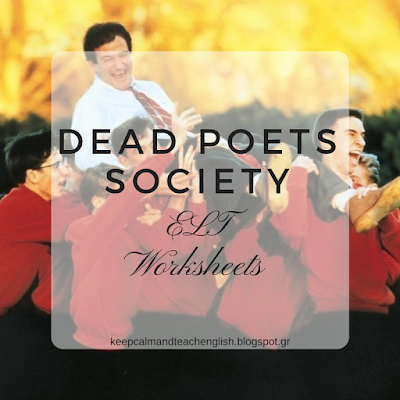
The 21st March is  World Poetry Day  and it is an excellent opportunity to show students a film I am particularly fond of (in fact most teachers are): Dead Poets Society. Dead Poets Society   is a 1989 American drama film directed by Peter Weir, written by Tom Schulman, and starring Robin Williams. Set in 1959 at the fictional elite conservative boarding school Welton Academy, it tells the story of an English teacher who inspires his students through his teaching of poetry. There are tons of worksheets out there for both native and EFL students focusing on different aspects of the film. The film itself is very rich in  literature material and can provoke discussions on many issues like poetry, conformity, education, the list goes on.  The following worksheets are inspired by the ones found on the internet so in this sense they are not original. However they are written with my students in mind (ideally 15-18 year olds at B1+ level) and ...

Fixed vs Growth Mindset

Image
After studying the behavior of thousands of children, Dr. Dweck coined the terms fixed mindset and growth mindset to describe the underlying beliefs people have about learning and intelligence.  When students believe they can get smarter, they understand that effort makes them stronger. Therefore they put in extra time and effort, and that leads to higher achievement. Our brain has enough plasticity meaning that we can increase our neural growth by the actions we take, such as using good strategies, asking questions, practicing, and following good nutrition and sleep habits. Studies on different kinds of praise have shown that telling children they are smart encourages a fixed mindset,  whereas praising hard work and effort cultivates a growth mindset. When students have a growth mindset, they take on challenges and learn from them, t hey are not afraid to fail therefore increasing their abilities and achievement.  In a recent interview , Dr Dweck...

SVOMPT: Basic Word Order in English

Image
One of the most important rules a learner of English should learn is basic word order in English. It is very common for Greek EFL learners to write incorrect sentences as Greek syntax is very flexible in terms of word order. The English language however follows stricter rules and any sentence that does not follow the rules not only sounds  wrong but is  in fact wrong. We tend to emphasize the order of certain words within a sentence, like for example adverbs of frequency, but we don't give our students enough practice on basic sentence structure.  photo by  stevepb The following lesson  has been in my mind for a long time as whenever I correct my students' writings I observe the same word order mistakes over and over again. I found an interesting diagram on SVOMPT in  engames.eu  but I decided to design it a bit different.  So here it is:

Famous People in History: An EFL Project

Image
Our coursebook presents the Past Simple tense via a number of famous historical figures like Mahatma Ghandi and Mother Teresa, and completes the unit with a biography project. In my attempt to make it a bit more motivating and to offer some guidance to my students, I've prepared a presentation on Adobe Spark , providing, among other things, a list of recommended websites for research and graphic organisers for note-taking.  Feel free to go through it and use it for inspiration! Leave me a comment below.

The Carnival and Mardi Gras

Image
Mardi Gras is a Carnival festival that lasts for several days and ends the day before Ash Wednesday. Mardi Gras is always on a Tuesday in February or March. It is the day before the start of Lent. Lent is a period of 40 days before Easter when many Christians fast.  photo by  Leamsii People celebrate Mardi Gras by having parties, attending parades, wearing costumes and masks, and eating King Cake. Because Lent is a somber time, Mardi Gras is a last chance to live it up and celebrate. Two of the largest Mardi Gras Carnival celebrations are in New Orleans and Rio de Janeiro . You can find all this information and more in the presentation below, together with downloadable worksheets, printable masks and a short video on the basic samba steps. Suitable for B1 teens. 

Safer Internet Day 2017

Image
Safer Internet Day 2017 will be celebrated globally on Tuesday 7th February with the slogan ‘Be the change: Unite for a better internet’.  The day offers the opportunity to highlight positive uses of technology and to explore the role we all play in helping to create a better and safer online community.  As young children and teens are more and more involved in social media without actual guidance, it is vital for schools to offer them advice on internet etiquette and safety  as well as model responsible behaviour and use.  The official page  of the campaign offers a gallery of resources in many languages together with lesson plans for students of all ages.  You can find ready made activities especially designed for EFL learners in the British Council . Levels range from A1 to C2 so there is something for everyone there. 

The Ultimate Critical Thinking Cheat Sheet

Image
The Critical Thinking Community defines critical thinking as the "intellectually disciplined process of actively and skillfully conceptualizing, applying, analyzing, synthesizing, and/or evaluating information gathered from, or generated by, observation, experience, reflection, reasoning, or communication, as a guide to belief and action." A critical thinker (among other things), raises vital questions and problems, formulating them clearly and precisely in order to reach conclusions and solutions. The Critical Thinking Skills Cheatsheet  helps you formulate a range of questions to help your students build critical thinking skills. The cheatsheet  includes categories for Who, What, Where, When, Why, and How. Each section has eight questions that begin with their corresponding word. The questions are meant to be versatile and broad, and applicable to a range of topics. You can download and print your own pdf infographic from the Global Digital Citiz...